People usually schedule one veneer consultation session, but it’s not the case. It’s usually four, spread out over five to eight weeks. And the part that catches almost everyone off guard? You’ll spend about a week walking around with temporaries in — something the practice brochure conveniently leaves out.
If you’ve been researching dental veneers in Edison and all you’ve come across so far is before-and-after photo galleries, you’re only seeing half the picture. Here’s the whole journey, stage by stage — what actually happens in the chair, and what you should be asking along the way.
The Two-Minute Check to Run Before You Book Anything
Start here. It’s free, and it rules out the worst-case scenario before you spend a dime.
If you are considering dental veneers Edison, take two minutes to look up your dentist on the New Jersey public license database before committing to treatment.
Why bother?
There’s an increasing trend of “veneers technicians” that lack proper license but aggressively market their services through social media. This issue was pointed out by the American Dental Association (ADA). It emphasized that any procedure which alters the structures of teeth, gums or jaw must always be performed by a licensed and qualified dentist.
ADA Warning:All dental treatment involving any alteration of your teeth or gums must be carried out by an authorized dentist. Non-compliance will result in irreparable harm.
Veneers change your teeth permanently. There’s no turning back once the enamel is taken off as it cannot grow back. That’s exactly why you need to verify credentials first and foremost.
Stage One: The Consultation
Duration: 45 to 60 minutes
Invasiveness: None — no drilling here
The dentist inspects your teeth and gums, and he/she may take x-rays and a whole set of photographs of you.Most Edison practices have swapped the old impression trays for a digital intraoral scan instead — it takes about five minutes and builds a 3D model of your mouth right on screen.
Then comes the honest part: not everyone is a candidate right away. An active form of gum disease, severe bruxism, or a tooth whose enamel is already thinned may lead to an entirely new solution. A competent dentist should notice such problems on the very first consultation, not on the fourth one.
4 Questions Worth Asking Before You Leave the Chair:
- How many teeth will really be treated, and why that many?
- Will I have a chance to see what a “trial smile” looks like before you do anything to my enamel?
- Who is your dental lab, and may I see samples of their work?
- What happens if my veneer chips three years down the road?
That last one gets skipped a lot. Ask it anyway — the answer tells you a lot about whether this practice sees your veneers as a decade-long relationship or a one-and-done transaction.
Stage Two: Design and the Trial Smile
Duration: About 45 minutes
Key Focus: Customization and getting your sign-off on the look
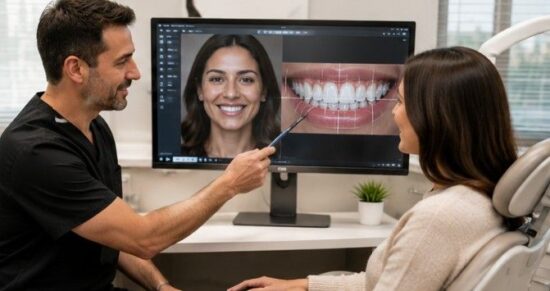
This is a step that is more important than many patients understand, and in fact many do not even know about its existence. Before any work is done on the teeth, the dentist creates your new smile via computer simulation and creates a physical model for your current set of teeth.
You get to see yourself in the mirror and decide on the length and shapes. Are you seeking something shorter and less round? Now is the time to tell us.
If a practice won’t offer a trial smile, take that as a sign to keep looking elsewhere. Browsing case galleries from practices offering dental veneers in Edison is still the quickest way to find a design style that matches what you actually want to see in the mirror.
Picking the Right Shade
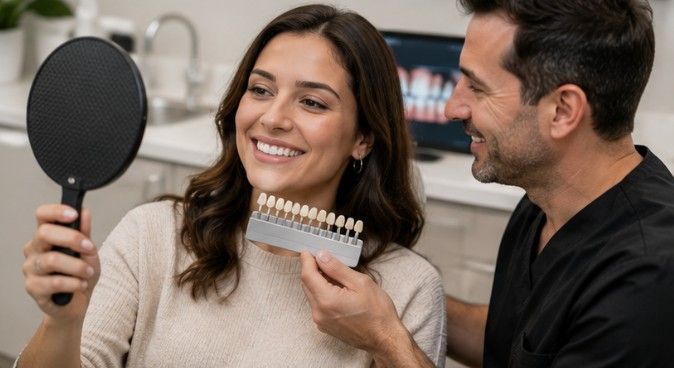
Real teeth aren’t a flat, uniform white — they’re a little translucent near the edges and warmer toward the gumline. Artificial lighting throws off how shades look, so ask to view your options near a window with natural light.
Stage Three: Prep Day
Duration: 2 to 3 hours
Anesthesia: Local anesthesia, yes
This is the point of no return. Your dentist shaves off a very thin layer of enamel from the front of each tooth being treated — usually around 0.5 millimeters, though it varies case by case.
That small amount of enamel removal is actually what keeps the finished porcelain from looking bulky or fake. After prep, a final scan or impression goes off to the lab, and you head home wearing temporary veneers.
| The Temporary Veneer Week |
| Why Care: Temporaries are held on with temporary cement so they can be removed cleanly later. |
| Guidelines During This 1–3 Week Window: |
| • Avoid Sticky Foods: Steer clear of caramel, taffy, chewy bagels, etc. |
| • Protect Front Teeth: Don’t bite straight into hard foods like apples or corn on the cob. |
| • Adjust Flossing Technique: Floss by sliding the floss out sideways instead of snapping it upward. |
| • Watch Staining Liquids: Go easy on coffee and red wine—temporary acrylic stains much faster than porcelain. |
Note: Temporaries can feel a little bulkier than your real teeth, and your speech might need 24–48 hours to catch up. If one comes loose, call the office right away — don’t try to glue it back on yourself.
Stage Four: Bonding Day
Duration: 90 minutes to 2 hours
Goal: Permanent placement and final tweaks
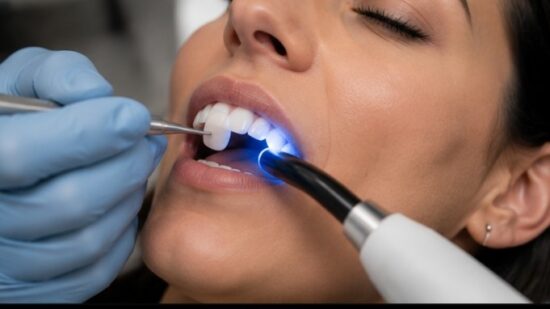
This is the appointment everything’s been building toward. First, the temporaries come off. Your dentist does a try-in with water or a special paste to check the fit, shade, and translucency before anything gets bonded for good.
Speak up here if something’s off. Once the cement sets, changes get a lot harder — and pricier.
Once you give the go-ahead:
- The tooth surface gets etched and prepped with an adhesive.
- The porcelain veneer is set into place.
- A curing light hardens the bonding cement in seconds.
- Extra cement gets trimmed away, and your bite gets checked with articulating paper.
- Any high spots are polished down so everything feels smooth and natural.
Stage Five: The Two-Week Follow-Up
Time taken: 20 minutes
Purpose: To tune bites and make plans for future maintenance
Although it seems like this brief visit is unnecessary, it is not true. In the first few weeks as you become accustomed to your mouth, some minor bite problems may arise which will be overlooked on bonding day.
This is also usually when you’d get fitted for a custom night guard if there are signs you grind your teeth. Nighttime grinding, worrying of gum diseases, without a doubt, is the number one cause for chipping of veneers.
Treatment Timeline Overview
| Stage | Time in Chair | Gap Before Next Visit |
| 1. Consultation & Records | 45–60 min | 1–2 weeks |
| 2. Design & Trial Smile | 45 min | 1 week |
| 3. Prep & Temporaries | 2–3 hours | 1–3 weeks (lab fabrication) |
| 4. Permanent Bonding | 90 min–2 hours | 2 weeks |
| 5. Follow-Up & Bite Check | 20 min | Regular 6-month checkups |
How Long Do Veneers Actually Last?
Evidence from clinical records show that porcelain veneers can serve an individual for many years when used properly.
A systematic review study on 25 clinical trials with 6,500 porcelain laminate veneers showed that the survival rate after ten years was 95%
Breaking that down by specific failure type, the numbers look even better:
- 96.3% survival rate against fracture
- 99.2% survival rate against debonding
- 99.3% survival rate against secondary tooth decay
Clinical Design Tip: Veneers designed to wrap over the biting edge (incisal coverage) tend to fail less often over time than designs that skip that coverage. Worth asking your dentist which approach they’re planning for your teeth.
Porcelain vs. Composite Veneers
| Feature | Porcelain Veneers | Composite Veneers |
| Material | Custom-crafted ceramic shells | High-grade dental resin, applied directly |
| Durability | Excellent — 10 to 15+ years | Decent — 5 to 7 years |
| Stain Resistance | Doesn’t stain | Can stain over time |
| Reversibility | Irreversible (requires enamel prep) | Often reversible, or minimally invasive |
| Best For | Full smile makeovers (6–8+ teeth) | One or two minor repairs, or a smaller budget |
If you’re treating six to eight front teeth and want something built to last a decade or more, porcelain is the better investment. Composite tends to make more sense for small touch-ups, younger patients, or anyone looking for a lower-commitment starting point.
Maintaining Your Smile for the Next 10+ Years
The natural tooth underneath and around your veneers can still decay, so long-term care still matters:
- Brush twice a day with a non-abrasive fluoride toothpaste.
- Floss daily around the edges of the veneers.
- Keep up with cleanings every six months.
- Wear a night guard if you clench or grind.
- Don’t use your front teeth as tools — no ripping open packaging or tearing tape.
Four appointments, a few weeks of waiting in between, and a week of eating carefully — that’s really the whole process. Once you know the actual timeline, going into your dental veneers Edison consultation feels a lot less like a leap of faith